Ask five vendors what your web application will cost and you will get five numbers that seem to describe different projects. One quotes $18,000. One quotes $140,000. Both sound confident.
Neither is necessarily lying. Software pricing varies more than almost any other professional service because "a web application" covers a two-week internal tool and a nine-month platform. This guide breaks down what you are actually paying for in 2026, so you can read a quote instead of guessing at it.
The headline comparison
These are blended rates for a mid-to-senior engineer working through an agency or development company, not the salary of an individual freelancer. They are indicative ranges, not a price list.
| Region | Typical blended hourly rate | What that usually buys |
|---|---|---|
| United States (major metro agency) | $120 – $250 | Senior engineers, full team, high overheads |
| United Kingdom / Western Europe | £70 – £150 / €80 – €170 | Similar seniority, slightly lower overheads |
| Australia | A$110 – A$220 | Small local market, high salary floor |
| Eastern Europe | €35 – €70 | Strong engineering, closer to EU time zones |
| India (established company) | $22 – $50 | Senior engineers, low cost base |
| India (bottom of the market) | $8 – $18 | Highly variable; often junior or subcontracted |
The gap between the last two rows matters more than the gap between countries. A $12 rate in India is not a better version of a $40 rate — it is usually a different service, staffed differently, with testing and code review quietly removed.
Where the saving actually comes from
It is worth being precise about this, because the answer determines whether the saving is safe to take.
A senior engineer in Pune costs a fraction of a senior engineer in San Francisco because rent, salaries, and office costs in Pune are a fraction of what they are in San Francisco. That is essentially the whole story. The engineer is not less experienced, and the code review is not shorter.
What the saving does not come from, in a company worth hiring:
- Skipping code review, automated tests, or CI
- Substituting juniors for the seniors who sold you the project
- Reusing a template and calling it custom
- Cutting the discovery phase and building the first thing described
If a quote is dramatically below the range above, one of those four is usually how. Ask directly which of them is included — the answer is informative either way.
The seven line items in any honest quote
Two quotes are only comparable once you know which of these each one contains. Ask for it in writing.
- Discovery and scoping. Requirements, edge cases, and the written scope everything else is measured against.
- Design. Wireframes, UI, and a clickable prototype before build starts.
- Frontend and backend development. The part everyone remembers to quote.
- Testing. Automated tests plus a real QA pass, not just the developer checking their own work.
- Infrastructure and deployment. Environments, CI/CD, secrets, monitoring.
- Project management. Someone accountable for the plan, the updates, and the demo.
- Post-launch support. A warranty period, then a maintenance arrangement.
A quote covering items 3 and 5 only will always look cheaper than one covering all seven. It is not cheaper. The other five items still have to happen, and they will be billed later as change requests, or skipped and paid for in rework.
The costs that do not appear in any proposal
Your own time. Offshore does not remove the need for someone on your side to answer questions and make decisions. Budget a few hours a week. Projects where the client is unreachable slip regardless of who is building.
Rework from unclear requirements. This is the single largest hidden cost in software, everywhere in the world. It is also the most preventable: a paid discovery phase costs a fraction of a month spent building the wrong thing.
Vendor changes mid-project. Moving a half-built codebase to a new team costs somewhere between 20% and 50% of what has been spent so far, because the new team has to read and trust code they did not write. This is the real cost of choosing on price alone and being wrong.
Running costs after launch. Hosting, domains, third-party APIs, app store fees, and — if your product uses AI models — per-request inference costs. These are small monthly numbers that add up, and they should be estimated before you build, not discovered on the first invoice.
Comparing cost per outcome, not cost per hour
The rate is a poor proxy for the total. A worked example that we see play out repeatedly:
- Vendor A: $15/hour, estimates 900 hours → $13,500. Delivers in 7 months, no tests, needs $6,000 of fixes in the first quarter.
- Vendor B: $38/hour, estimates 420 hours → $15,960. Delivers in 3 months, tested, and the next feature takes days instead of weeks.
Vendor B costs 18% more on paper, arrives four months sooner, and leaves behind something you can build on. If those four months are four months of revenue, the comparison is not close.
How to structure the commercial side
Fixed price works when the scope is genuinely definable — a marketing site, a well-specified MVP, a migration. It puts estimation risk on the vendor, which is where it belongs.
Monthly retainer works for ongoing product development where the roadmap will change. You are buying capacity, not a defined artefact.
Time and materials aligns incentives worst of the three: the vendor earns more the longer it takes. If a vendor will only work this way for a well-defined scope, ask why.
Whichever you pick, tie payment to milestones you can see. Paying 50% upfront on a four-month build means being three months in with no leverage and no working software.
Five questions worth asking before you sign
- Who specifically will write the code, and can I interview them?
- Which of the seven line items above is inside this number?
- What is your code review and testing process, in writing?
- When does IP transfer to me, and what exactly do I receive?
- What happens if we want to stop after milestone two?
The answers matter less than the willingness to answer. A vendor who cannot give you a straight response to question 4 before you sign will not be more forthcoming after.
The short version
Offshore rates in India are genuinely 50–75% below US and UK agency rates, and that gap is real and structural. But it is a gap in cost base, not a discount on engineering. The cheapest quote in your inbox is usually cheap because something in the seven line items has been removed, and you will pay for it later at a worse moment.
Compare what is included. Compare cost per delivered outcome. And pay in milestones so you always keep the option to walk.
Frequently asked questions
For equivalent seniority, Indian rates typically land at 25–40% of US agency rates and 30–50% of UK or Western European rates. The saving comes from cost of living and office overheads, not from lower skill — but it only holds if you compare like for like on seniority and on what is actually included.
Because they are rarely quoting the same thing. One includes design, testing, CI/CD and project management; another quotes only the coding hours and bills everything else as change requests. Always ask which of those seven line items is inside the number before comparing two quotes.
The four that catch people out are: your own management time, rework caused by unclear requirements, the cost of a mid-project vendor change, and ongoing infrastructure and third-party service fees after launch. A good vendor puts all four in the proposal rather than discovering them with you later.
No. A senior engineer at twice the rate who takes a third of the time is cheaper in total, and leaves you a codebase you can extend. Compare cost per delivered outcome, not cost per hour.
Fixed price suits well-defined scopes and puts the estimation risk on the vendor. Monthly retainers suit ongoing product work where the roadmap will change. Pure hourly billing is the model with the weakest alignment: it rewards the vendor for taking longer.

Written by the Lunexa Technologies team
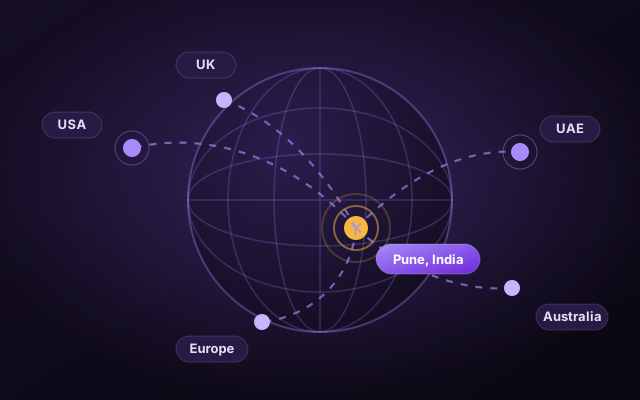
We are a product engineering company in Pune, India, building websites, web apps, mobile apps, AI features, and cloud infrastructure for companies across the US, UK, UAE, Europe, Australia, and India.
Have a project in mind?
Tell us what you need and we will send a clear, fixed-price quote — usually within one business day.