If you have asked three agencies what a website costs, you have probably had three answers an order of magnitude apart. ₹9,000 from one, ₹90,000 from another, ₹4,50,000 from the third — all apparently for the same thing.
They are not describing the same thing. This guide sets out what you are actually paying for in 2026, with realistic ranges for the Indian market, so you can judge a quote rather than guess.
Realistic price ranges
These assume custom design and clean, modern code — not a marketplace template with your logo dropped into it.
| Type of website | Typical range | Timeline | Suits |
|---|---|---|---|
| Landing page (single page) | ₹15,000 – ₹40,000 | 3–7 days | Campaigns, launches, lead capture |
| Business website (5–8 pages) | ₹45,000 – ₹1,50,000 | 2–4 weeks | Clinics, consultancies, local services |
| Website with CMS | ₹1,00,000 – ₹2,50,000 | 4–6 weeks | Teams who publish regularly |
| E-commerce store | ₹1,50,000 – ₹6,00,000 | 5–10 weeks | Retailers selling online |
| Custom web application | ₹4,00,000+ | 8 weeks+ | Portals, dashboards, SaaS |
International clients will notice these numbers are well below what the same work costs in the US, UK, or Gulf. That gap is cost of living and overheads, not a difference in the engineering.
What actually moves the price
The number of unique page designs. Not the number of pages. Twenty product pages sharing one template is one design. Six pages that each look different is six. This is the biggest single driver, and it is the one clients most often mis-estimate.
Custom design versus a template. A custom design means research, wireframes, revisions, and a look nobody else has. A template means faster and cheaper, and a site that resembles several thousand others. Both are legitimate; they are just not the same purchase.
Functionality. Every login, payment, booking flow, or integration is engineering work with its own edge cases. "Just add a login" is roughly a week of work once you include password reset, session security, and error handling.
Who writes the content. This is the most underestimated line in any website project. If you supply finished copy and images, the project moves fast. If the agency writes it, add cost and weeks. If nobody writes it, the project stalls — and this is why most late websites are late.
Whether SEO and testing are included. Semantic markup, structured data, performance tuning, cross-browser and mobile testing. A quote that omits these is cheaper because it is smaller, not because it is better value.
The ongoing costs
Budget for these before you start, not when the first invoice arrives.
- Domain: ₹900 – ₹1,600 a year
- Hosting: free on modern platforms for a static site, up to ₹15,000 a year for a WordPress or application host
- SSL certificate: free with any reputable host — never pay separately for a basic certificate
- Maintenance: ₹8,000 – ₹45,000 a year for updates, security patches, backups, and small changes
- Email: ₹1,500 – ₹3,500 per user per year for a professional mailbox on your domain
Most small business sites cost ₹12,000 to ₹35,000 a year to run. If a proposal does not mention ongoing costs at all, ask — it does not mean there are none.
Why very cheap websites usually cost more
The ₹8,000 website is not a smaller version of the ₹80,000 one. It is typically:
- Built on a bloated template, loading several seconds on mobile
- Structurally unable to rank, because the markup and speed work was never done
- Impossible to edit yourself, so every text change is a paid request
- Undocumented, so the next developer quotes a rebuild rather than a fix
- Not actually yours, if it sits on the builder's account
Businesses that start here typically rebuild within two years. Two builds cost more than one done properly, and the intervening two years of poor search visibility cost more again.
What a properly built site includes in 2026
- Mobile-first design, because that is where most of your visitors are
- Fast Core Web Vitals — Google measures loading, interactivity, and layout stability, and users leave slow pages
- Semantic HTML and structured data, so search engines can read what your business does and where it is
- Accessibility basics: contrast, keyboard navigation, alternative text
- Working conversion paths: forms that reach you, WhatsApp, click-to-call, and Google Maps for a local business
- Analytics configured so you can tell which pages produce enquiries
- A handover with the source code, the accounts, and the credentials in your name
That last item is worth insisting on in writing. It is the difference between owning a website and renting one.
Getting a comparable quote
Ask every vendor for the same breakdown:
- How many unique page designs?
- Custom design or template — and how many revision rounds?
- Who writes the copy and supplies the images?
- Is a CMS included, and can our team use it without training?
- What SEO work is in scope?
- What testing is done, on which devices and browsers?
- What do we own at the end, and when is it transferred?
- What does year one cost to run?
Two quotes only become comparable once you have those eight answers. In practice, asking is also a useful filter: a vendor who answers precisely will manage the project precisely.
The short version
A serious business website in India in 2026 sits between ₹45,000 and ₹1,50,000, plus ₹12,000 to ₹35,000 a year to run. The price is driven by unique designs, custom versus template, functionality, and who writes the content.
Very cheap sites are cheap because something necessary was left out, and you pay for it later in rebuilds and lost search traffic. Get the eight answers above in writing, and insist that everything is transferred into your own name at handover.
Frequently asked questions
A professional 5–8 page business website typically costs ₹45,000 to ₹1,50,000. Adding a CMS so your team can edit content usually puts it in the ₹1,00,000 to ₹2,50,000 range. Budget a further ₹12,000 to ₹35,000 a year for hosting, domain, and maintenance.
Because a website can mean a five-page brochure or a custom platform. The main drivers are the number of unique page designs, custom design versus a template, functionality such as logins or payments, who writes the content, and whether SEO and testing are included.
Rarely. At that price you are getting a template with your logo on it, usually slow, rarely optimised for search, and difficult to extend. Most businesses that start there rebuild within two years, which costs more than doing it properly once.
A domain at ₹900 to ₹1,600 a year, hosting from free to around ₹15,000 a year depending on the stack, and maintenance covering updates, security, and backups at ₹8,000 to ₹45,000 a year. SSL is free with any reputable host.
A landing page takes 3–7 days, a business website 2–4 weeks, and a larger site with a CMS 4–6 weeks. Content readiness is almost always the limiting factor, not development.

Written by the Lunexa Technologies team
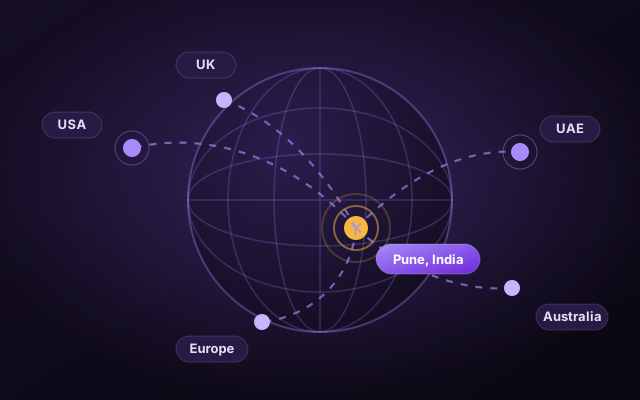
We are a product engineering company in Pune, India, building websites, web apps, mobile apps, AI features, and cloud infrastructure for companies across the US, UK, UAE, Europe, Australia, and India.
Have a project in mind?
Tell us what you need and we will send a clear, fixed-price quote — usually within one business day.